Erbium vs CO₂ · Newport News
Erbium vs CO2 laser resurfacing, explained.
Two lasers, one target, very different personalities.
If you’ve searched “erbium vs CO2 laser,” you’ve probably found a dozen pages that all agree with whichever laser the writer owns. This one is different in one way: we own an erbium:YAG laser and we don’t own a CO₂, and by the end you’ll know exactly when we’d send you to someone who does.
Both lasers do the same job. Both are ablative resurfacing lasers, which means they remove the outer layer of skin in a controlled way so that newer, smoother skin heals in its place. The differences come down to one piece of physics, and once you see it, the whole comparison becomes obvious.
What “resurfacing” actually means
Think of an old hardwood floor. Years of foot traffic leave it scuffed, dull, and uneven. You don’t fix that by painting over it. You sand off the damaged surface and let the fresh wood underneath become the new surface.
Skin resurfacing is the sanding step. The laser vaporizes a very thin layer of skin, precisely and evenly, and your body does the rest: new epidermis grows across the treated area within about a week, and over the following months the dermis underneath lays down fresh collagen. That’s why texture, fine lines, sun damage, and shallow scars improve.
The two lasers that do this well are erbium:YAG and CO₂. They differ in how much heat they leave behind after the sanding, and that’s the whole story.
Both lasers aim at the same target: water
Your skin is mostly water. Both lasers are tuned to wavelengths that water absorbs, so when the pulse arrives, the water in the top layer of skin absorbs the energy, flashes to steam, and carries that layer of tissue away with it. No cutting, no chemicals. Just very fast, very shallow boiling.
Here’s the key difference. Water absorbs the erbium wavelength (2,940 nm) roughly 13 to 16 times more strongly than it absorbs the CO₂ wavelength (10,600 nm) [1][2]. Stronger absorption means the energy is used up in a thinner slice of tissue. Weaker absorption means the energy travels deeper before it’s spent, and the tissue it passes through gets heated rather than vaporized.
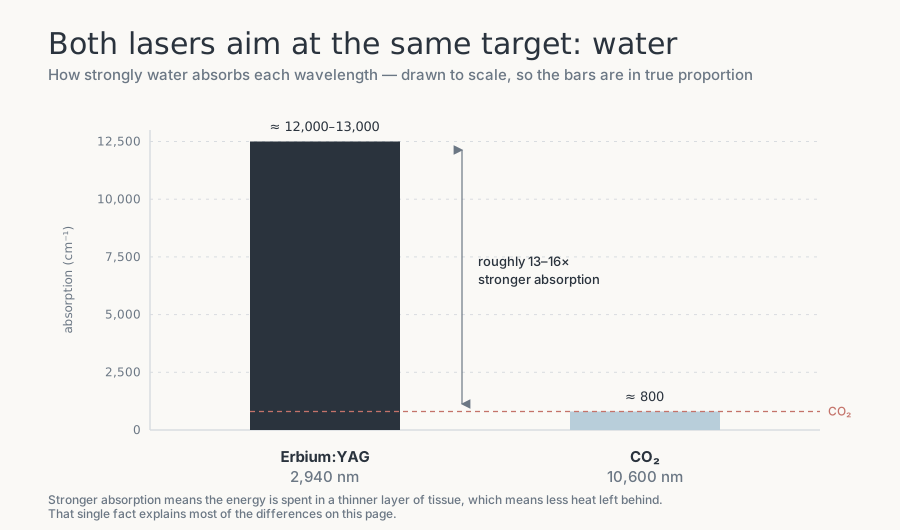
Water absorbs erbium’s wavelength roughly 13–16 times more strongly than CO₂’s. That one number drives most of the differences below.
The chisel and the hot spoon
An erbium pulse behaves like a very sharp chisel. At the fluences used for resurfacing it takes off roughly 10 to 40 microns of tissue per pass, and the band of surviving tissue it heats underneath is about 10 to 50 microns thick — thinner than a sheet of paper [3][17]. A CO₂ pulse behaves like a hot spoon: a pulsed system removes roughly 20 to 100 microns per pass, and leaves a heated zone underneath of about 50 to 150 microns [4][5][18].
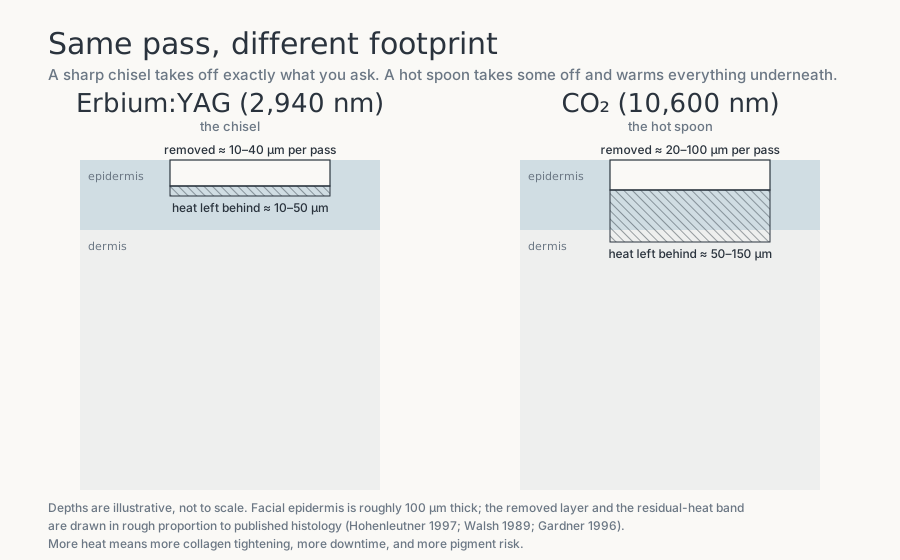
Same pass, different footprint. Illustrative depths based on published histology (see sources).
Those are two different measurements, and running them together is where most published comparisons of these two lasers go wrong. How much tissue comes off is the ablation depth, and it is set by the energy density you dial in — quoting it without the setting is meaningless. How much surviving tissue underneath got heated is the residual thermal damage zone, and that is where the two lasers genuinely part company. Anything that gives you a single number for “depth” has fused the two together. Four separate quantities get confused this way, so here they are apart:
| What is being measured | Erbium:YAG (2,940 nm) | CO₂ (10,600 nm) |
|---|---|---|
| How strongly water absorbs the wavelength | ~12,000–13,000 cm⁻¹, near the peak | ~800–860 cm⁻¹, roughly 13–16× lower [2] |
| How far the light itself reaches (optical penetration) | ~1 µm in water; 1–3 µm in skin | ~12–20 µm [2] |
| How much tissue one pass removes (ablation depth) | ~10–40 µm at 5–15 J/cm² [3] | ~20–100 µm, pulsed systems [5] |
| How much surviving tissue is heat-damaged (coagulation zone) | ~10–50 µm in short-pulse mode; more with stacked passes or a coagulation pulse [3][17] | ~50–150 µm; 115 ± 15 µm in one scanned-handpiece series [18] |
Two caveats we would rather state than bury. The ablation figures only hold at the settings named beside them; turn the energy up and the number goes up with it. And “erbium leaves almost no heat behind” is a claim about short pulses and few passes. Stack enough passes on one spot and the heated band widens toward 100 microns [3], and a deliberate coagulation pulse widens it further — which is the whole point of that mode, but it means the headline is a setting, not a property of the laser.
That leftover heat is not simply a flaw. Heat coagulates small blood vessels, so CO₂ treatments bleed less. Heat also shrinks and stimulates collagen, so CO₂ produces more immediate tightening per pass. But heat is also what prolongs redness, slows healing, and, most importantly for this page, provokes pigment cells. More heat, more downtime, more pigment risk. Less heat, faster healing, less tightening. Every trade-off between these two lasers is a version of that sentence.
Erbium:YAG — the precise one
What it is. A solid-state laser built around a yttrium-aluminum-garnet crystal doped with erbium. It fires at 2,940 nm, which happens to sit almost exactly on the peak of water’s absorption curve. That’s not a coincidence; it’s why the crystal was chosen for skin.
How it treats. Short pulses remove tissue a few microns at a time, so depth is controlled by the number of passes. Erbium lasers as a class can be built to work fractionally, drilling columns of tissue into the upper dermis and leaving intact skin between them to speed healing. Ours has no fractional lens, and we won’t describe a capability we don’t have: what we offer is a light peel through full-field resurfacing, with the depth targeted to your goals. A light peel stays superficial; a deeper full-field pass takes the whole surface and can go further for scars and etched-in lines. Modern erbium lasers, including ours, can also run longer “coagulation” pulses that deliberately add some heat when we want more tightening, which narrows the gap with CO₂ when that’s the goal.
What it’s best at. Fine lines, sun damage and rough texture, superficial and moderate acne scars, benign surface lesions (seborrheic keratoses, milia, skin tags), precise work on the neck, chest and hands, and, with the right protocol, resurfacing in darker skin types where CO₂ is a much harder sell.
What it costs you. Faster healing (typically re-epithelialized in about five days [6]), redness measured in weeks rather than months, and a lower risk of the permanent color loss that can follow aggressive CO₂. In exchange, less tightening per session, and deep scars or heavy wrinkling may need more sessions.
CO₂ — the powerful one
What it is. A gas laser: an electrical discharge through a carbon dioxide mixture produces light at 10,600 nm, deep in the infrared. It’s the oldest laser still in everyday medical use.
How it treats. Older CO₂ lasers ran continuously and cooked tissue as much as they removed it. Modern ones fire very short, high-energy pulses that vaporize tissue before too much heat can spread, and most are now “fractional”: instead of treating the entire surface, they drill thousands of microscopic columns and leave the skin between them intact as a healing scaffold.
What it’s best at. Deep, etched wrinkles, especially around the mouth. Significant skin laxity. Deep, rolling acne scars. Situations where the collagen tightening from heat is the point, not a side effect. In fair skin with heavy damage, a well-done CO₂ treatment can accomplish in one session what erbium takes two or three to reach.
What it costs you. Longer healing, redness that can last months, more pain, and a real risk profile: post-treatment darkening in most skin types [6], and delayed lightening of the skin, sometimes permanent, that can appear months later after aggressive full-field treatment [7]. In darker skin, darkening after CO₂ is common enough that many careful practices avoid full-field CO₂ entirely for those patients [8][9].
A short history of each
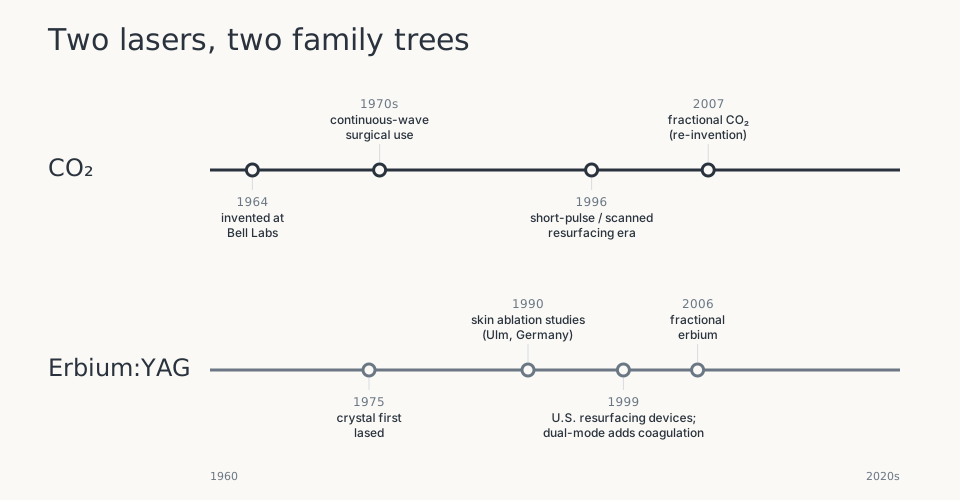
Two family trees. CO₂ is older and had to be re-invented twice; erbium arrived precisely because of CO₂’s early problems.
CO₂ came first. The CO₂ laser was invented in 1964 by C. Kumar N. Patel at Bell Labs. By the 1970s and 80s it was a surgical cutting tool, and dermatologists were using it to remove lesions, but as a continuous-wave device it left so much heat behind that resurfacing with it meant charring, slow healing and scars. The breakthrough came in the mid-1990s with short-pulse and rapidly scanned CO₂ systems that could vaporize tissue faster than heat could spread [10]. The late 1990s were the CO₂ resurfacing boom. Then the bills came due: prolonged redness, infections, and a pattern of delayed hypopigmentation appearing a year or more after treatment [7]. Demand fell hard. CO₂’s second act came in 2004 with the concept of fractional photothermolysis [11] and, in 2007, the first fractional CO₂ devices [12], which kept most of the benefit while cutting the downtime and the worst of the risk.
Erbium arrived as the answer to CO₂’s problems. The erbium:YAG crystal was first made to lase in the mid-1970s and found early homes in dentistry and eye surgery. Its use on skin was worked out at the University of Ulm in Germany around 1989–1990, where Kaufmann and Hibst showed that pulsed 2,940 nm light produced clean ablation craters with minimal damage to the surrounding tissue [1]. Erbium resurfacing devices entered U.S. practice in 1996–1997, marketed specifically as the gentler alternative to CO₂. The first generation’s weakness was the flip side of its strength: with so little heat, it didn’t stop bleeding well and didn’t tighten much. Around 1998–2000 manufacturers added longer, coagulating pulse modes (“dual-mode” or “variable-pulse” erbium) that let the operator dial in heat on purpose [13]. Fractional erbium devices followed in the mid-2000s, though not every erbium platform carries the lens for them — ours does not. Today’s erbium lasers can span from superficial work to “near-CO₂” depending on how they’re driven.
Head to head
| Property | Erbium:YAG (2,940 nm) | CO₂ (10,600 nm) |
|---|---|---|
| Water absorption | Very high (peak) | High, but ~13–16× lower |
| Tissue removed per pass | ~10–40 µm at 5–15 J/cm² | ~20–100 µm, pulsed |
| Residual heat-damaged tissue | ~10–50 µm, short-pulse | ~50–150 µm |
| Depth control | Micron-level, by passes | Coarser; depth and heat rise together |
| Collagen tightening per session | Modest (more with coagulation mode) | Strong |
| Bleeding during treatment | Some (pinpoint) | Minimal (heat seals vessels) |
| Re-epithelialization | ~5 days | ~5–10 days depending on depth and technique |
| Redness | Weeks | Weeks to months |
| Pain | Moderate; topical numbing usually enough for lighter treatments | Higher; deeper treatments often need nerve blocks or sedation |
| Post-treatment darkening (PIH) | Possible, shorter-lived at matched depth [6] | Possible, common in darker skin [8][9] |
| Permanent lightening (hypopigmentation) | Rare | Documented after aggressive full-field treatment [7] |
| Best for | Fine lines, texture, sun damage, shallow-to-moderate scars, surface lesions, darker skin with care | Deep wrinkles, laxity, deep scars, fair skin with heavy damage |
| Sessions for a big goal | Often 2–3 | Often 1 |
| Typical cost per session | Lower | Higher |
| Offered here | Yes | No (we’ll refer you) |
The trap: “erbium is safe, CO₂ isn’t”
Here is the honest version, because the simple version is wrong.
When researchers have compared the two lasers at matched depths of injury, the pigment complication rates come out similar. In one well-known series, temporary darkening followed 42% of erbium treatments and 46% of single-pass CO₂ treatments, lasting about 11 and 13 weeks respectively [6]. A side-by-side trial that dialed both lasers to produce equivalent wounds found equivalent healing [14]. The lesson: it’s the depth and heat of the injury that raises pigment risk, not the name on the laser.
What erbium gives you is control. Because it removes tissue in tiny increments with almost no collateral heat, we can do a truly superficial treatment, one that stays within the epidermis and barely warms the dermis, and know that’s what we did. CO₂ is a blunter instrument at the shallow end of the range. That’s why erbium is the resurfacing laser we’ll use in darker skin, and why we still don’t use it casually there.
Why erbium is our choice for darker skin, with caution
Melanin doesn’t absorb the erbium wavelength meaningfully, which is good news; the laser isn’t targeting your pigment. The risk is indirect: any wound in skin that makes a lot of melanin can heal darker for a while (post-inflammatory hyperpigmentation), and the deeper and hotter the wound, the more likely and longer-lasting that is. Series in East Asian patients, who are mostly types III–V, have found darkening after erbium resurfacing to be common but temporary, and more frequent after deeper treatments [15][16].
So “with caution” isn’t a disclaimer. It’s a protocol:
- Fitzpatrick types I–V are candidates for erbium resurfacing here. Type VI is treated too, with added caution — a test spot, lighter passes and longer intervals.
- We test before we treat. A small test spot, read at the right interval for your skin, before any full-field treatment in types IV–V.
- We go shallow and stage it. Two lighter sessions beat one aggressive one every time in darker skin. If someone offers you a deep single-session resurfacing on type V skin, that’s a red flag, not a bargain.
- We prepare the skin. Strict sun avoidance for weeks before, a prescription pre-treatment regimen where it’s indicated, and no treatment on tanned skin, ever. The laser can’t tell a tan from a target.
- We plan for the darkening in advance. If it happens, we already know what we’re doing about it: sunscreen, topical treatment, and time. It’s expected, it’s temporary, and you’ll hear that from us before your first session, not after.
If that sounds slower and more conservative than what you’ve been quoted elsewhere, it is. That’s on purpose.
There is a great deal more to say about this, and we said it: our full guide to laser and energy treatments in darker skin covers which devices we use, which we refuse, and why.
What we offer, and what it costs
Erbium:YAG resurfacing here is performed only by Adam Medlin, FNP-BC, on the Rohrer Spectrum platform. The light peel across the full face can be booked online; full-field resurfacing is planned at a free consultation first, because the right depth and the right candidate can’t be decided from a menu.
| Erbium:YAG treatment | Price |
|---|---|
| Light Er:YAG peel — full face | $700 |
| Full-field Er:YAG resurfacing — full face | $1,200 |
| Er:YAG hand resurfacing, per session | $450 |
| Er:YAG treatment of discrete actinic keratoses, per lesion cluster | $200 |
Resurfacing depth is chosen at consultation, so if you are between the light peel and full-field, that is a conversation rather than a guess. Full details of the resurfacing service, including what to expect during healing, are on our laser resurfacing page. Benign lesion removal with the same laser is priced separately on that page.
When we’d send you to a CO₂ laser
We don’t own a CO₂, and pretending erbium does everything would be the kind of thing this practice exists to not do. We’ll refer you out when:
- You have deep, etched perioral or periorbital wrinkles in fair skin and want the maximum change in one session.
- Your main concern is laxity rather than texture, and you’re a candidate for the tightening that only a hot laser delivers.
- You have deep, rolling acne scars in fair skin where fractional CO₂ has the stronger track record.
In those cases a good fractional CO₂ in experienced hands is the better tool, and we’d rather you get the better tool.
Questions
Is erbium or CO₂ laser better?
Neither is “better.” Erbium removes tissue with almost no residual heat, so it heals faster and is safer in darker skin; CO₂ leaves more heat, which tightens more but costs more downtime and more pigment risk. Erbium is the better tool for fine lines, texture, sun damage, moderate scars and darker skin. CO₂ is the better tool for deep wrinkles and laxity in fair skin.
Which is safer for dark skin, erbium or CO₂?
Erbium, used conservatively. Its precision lets us stay shallow and cool, which is what protects pigment. But depth matters more than the laser’s name: a deep erbium treatment carries real darkening risk too, which is why we test-spot, go lighter, and stage sessions in types IV–V.
Can you do laser resurfacing on dark skin at all?
Yes, for Fitzpatrick types IV–V with a conservative erbium protocol. Type VI is treated with added caution. If we don’t think we can treat you safely, we’ll say so and point you to a non-laser option instead.
Does erbium laser resurfacing hurt?
Lighter treatments feel like hot pinpricks and are handled with topical numbing. Deeper treatments are more intense and we plan pain control accordingly. It’s over quickly; a full face takes well under an hour.
How long is the downtime after erbium laser resurfacing?
Most people re-epithelialize in about five days. Expect swelling and weeping for the first two to three days, pinkness for a few weeks after lighter treatments and longer after deeper ones. Makeup is usually fine once the skin has closed.
How many erbium sessions will I need?
One for surface lesions and light texture work. Two or three, spaced a month or more apart, for acne scars or deeper lines. We’d rather stage than over-treat, especially in darker skin.
Is fractional CO₂ safe for dark skin?
Safer than full-field CO₂, but post-treatment darkening remains the most common complication in types III–V in published series [9]. We don’t offer CO₂; if you’re a strong CO₂ candidate we’ll refer you and tell you what to ask about.
What does erbium laser resurfacing cost in Newport News?
Here, $700 for a light peel across the full face and $1,200 for full-field resurfacing of the full face, with the rest of the prices listed above. Consultations are free.
Sources
- Kaufmann R, Hibst R. Pulsed 2.94-µm erbium-YAG laser skin ablation — experimental results and first clinical application. Clin Exp Dermatol. 1990;15(5):389–393. doi:10.1111/j.1365-2230.1990.tb02125.x
- Hale GM, Querry MR. Optical constants of water in the 200-nm to 200-µm wavelength region. Appl Opt. 1973;12(3):555–563. doi:10.1364/AO.12.000555 (source for the water absorption figures at 2.94 µm versus 10.6 µm).
- Hohenleutner U, Hohenleutner S, Bäumler W, Landthaler M. Fast and effective skin ablation with an Er:YAG laser: determination of ablation rates and thermal damage zones. Lasers Surg Med. 1997;20(3):242–247. PubMed
- Alster TS, Lupton JR. Erbium:YAG cutaneous laser resurfacing. Dermatol Clin. 2001;19(3):453–466. doi:10.1016/s0733-8635(05)70286-2
- Ross EV, Naseef GS, McKinlay JR, et al. Comparison of carbon dioxide laser, erbium:YAG laser, dermabrasion, and dermatome: a study of thermal damage, wound contraction, and wound healing in a live pig model. J Am Acad Dermatol. 2000;42(1 Pt 1):92–105. PubMed
- Tanzi EL, Alster TS. Single-pass carbon dioxide versus multiple-pass Er:YAG laser skin resurfacing: a comparison of postoperative wound healing and side-effect rates. Dermatol Surg. 2003;29(1):80–84. doi:10.1046/j.1524-4725.2003.29012.x (re-epithelialization 5.5 versus 5.1 days; erythema 4.5 versus 3.6 weeks; hyperpigmentation 46% versus 42%, lasting 12.7 versus 11.4 weeks).
- Bernstein LJ, Kauvar AN, Grossman MC, Geronemus RG. The short- and long-term side effects of carbon dioxide laser resurfacing. Dermatol Surg. 1997;23(7):519–525. PubMed
- Ruiz-Esparza J, Lupton JR. Laser resurfacing of darkly pigmented patients. Dermatol Clin. 2002;20(1):113–121. PubMed
- Chan NP, Ho SG, Yeung CK, Shek SY, Chan HH. Fractional ablative carbon dioxide laser resurfacing for skin rejuvenation and acne scars in Asians. Lasers Surg Med. 2010;42(9):615–623. doi:10.1002/lsm.20974
- Fitzpatrick RE, Goldman MP, Satur NM, Tope WD. Pulsed carbon dioxide laser resurfacing of photo-aged facial skin. Arch Dermatol. 1996;132(4):395–402. PubMed
- Manstein D, Herron GS, Sink RK, Tanner H, Anderson RR. Fractional photothermolysis: a new concept for cutaneous remodeling using microscopic patterns of thermal injury. Lasers Surg Med. 2004;34(5):426–438. doi:10.1002/lsm.20048
- Hantash BM, Bedi VP, Kapadia B, et al. In vivo histological evaluation of a novel ablative fractional resurfacing device. Lasers Surg Med. 2007;39(2):96–107. doi:10.1002/lsm.20468
- Rostan EF, Fitzpatrick RE, Goldman MP. Laser resurfacing with a long pulse erbium:YAG laser compared to the 950 ms pulsed CO2 laser. Lasers Surg Med. 2001;29(2):136–141. doi:10.1002/lsm.1099
- Ross EV, Miller C, Meehan K, et al. One-pass CO2 versus multiple-pass Er:YAG laser resurfacing in the treatment of rhytides: a comparison side-by-side study of pulsed CO2 and Er:YAG lasers. Dermatol Surg. 2001;27(8):709–715. PMID 11493293
- Polnikorn N, Goldberg DJ, Suwanchinda A, Ng SW. Erbium:YAG laser resurfacing in Asians. Dermatol Surg. 1998;24(12):1303–1307. PMID 9865193
- Kim YJ, Lee HS, Son SW, Kim SN, Kye YC. Analysis of hyperpigmentation and hypopigmentation after Er:YAG laser skin resurfacing. Lasers Surg Med. 2005;36(1):47–51. doi:10.1002/lsm.20120
- Walsh JT, Flotte TJ, Deutsch TF. Er:YAG laser ablation of tissue: effect of pulse duration and tissue type on thermal damage. Lasers Surg Med. 1989;9(4):314–326. doi:10.1002/lsm.1900090403 (normal-spiking-mode pulses leave 10–50 µm of collagen damage, up to ~100 µm at ~80 J/cm²).
- Gardner ES, Reinisch L, Stricklin GP, Ellis DL. In vitro changes in non-facial human skin following CO2 laser resurfacing: a comparison study. Lasers Surg Med. 1996;19(4):379–387. doi:10.1002/(SICI)1096-9101(1996)19:4<379::AID-LSM1>3.0.CO;2-P (zone of thermal denaturation 115 ± 15 µm with the SilkTouch scanning handpiece, independent of pass number).
This page reflects our clinical position as of the review date above. Evidence in aesthetic medicine changes, and when it does, this page changes. Peninsula Aesthetic Medicine · Newport News, Virginia.
Newport News · Virginia
Start with a consultation. It’s free.
Every plan here starts with a conversation. Bring your questions — we’ll give you a realistic picture of what each option can and can’t do, including when the answer is to wait or to start somewhere simpler.
Takes about a minute. You'll come back here to a confirmation page when you're booked — if you don't get there, call (757) 586-4575, any hour.