Skin of Color · Newport News
Laser and energy treatments for darker skin.
Melanin isn’t a contraindication. It’s a design constraint.
If you have brown or Black skin and you’ve been told “we don’t treat your skin type,” or worse, been treated by someone who shouldn’t have, this page is for you. Laser treatments for darker skin are not inherently unsafe. Some devices are unsafe in darker skin, some are safe only when driven correctly, and a few don’t care what color you are at all. Knowing which is which is most of the job.
We’re a nurse practitioner–led aesthetic medicine practice in Newport News, and a large share of the people who walk in here are Fitzpatrick IV, V or VI. What follows is how we think about treating them, what we use, what we refuse to use, and one under-discussed complication that deserves its own section.
The Fitzpatrick scale, briefly
In 1975 a Harvard dermatologist named Thomas Fitzpatrick needed a quick way to sort patients for a light-based psoriasis treatment: how badly do you burn, and how well do you tan? His original scale had four types, all for white skin. Types V and VI were added in 1988 to cover brown and Black skin [17].
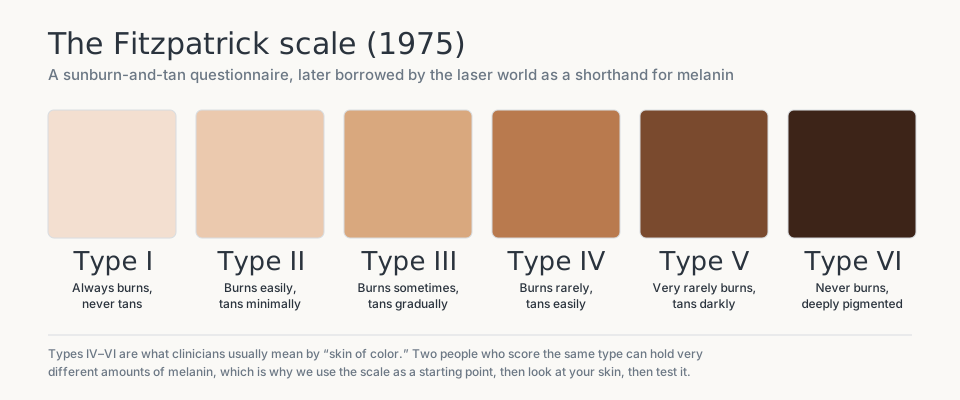
The Fitzpatrick scale. Designed to describe sunburn, borrowed to describe melanin. Useful, imperfect.
Two things to know about it. First, it’s a questionnaire about sunburn, not a measurement of melanin. Two people who both answer “rarely burns, tans easily” can have quite different amounts of pigment in the epidermis, and it’s the pigment that the laser interacts with. Second, it was never designed to predict laser risk; the laser world adopted it because it was already there. We use it, but as a starting point. Your actual skin, examined under magnification and, for higher-risk treatments, tested with a small spot before we commit, is what decides settings.
You’ll see “skin of color” used to mean roughly types IV–VI. That’s how we use it here.
How lasers see skin
Lasers don’t see “skin.” They see three things that absorb light: water, blood (hemoglobin), and pigment (melanin). Each treatment picks a wavelength that one of those targets absorbs more than the others, and delivers energy fast enough to heat the target before the heat can spread. That principle, selective photothermolysis, is the basis of every light-based treatment since 1983.
The problem in darker skin is that the target and the bystander are made of the same stuff. When we want to disable a hair follicle, we’re aiming at the melanin in the hair. When we want to fade a sun spot, we’re aiming at the melanin in the spot. But the epidermis over the top is full of melanin too, and it’s in the way. Picture trying to warm one dark stone at the bottom of a shallow pond using a heat lamp, when the surface of the pond is also dark. Most of the energy gets grabbed at the surface before it reaches the stone. The stone stays cool and the surface burns.
Wavelength is the way out. Melanin absorbs short wavelengths strongly and long wavelengths weakly.
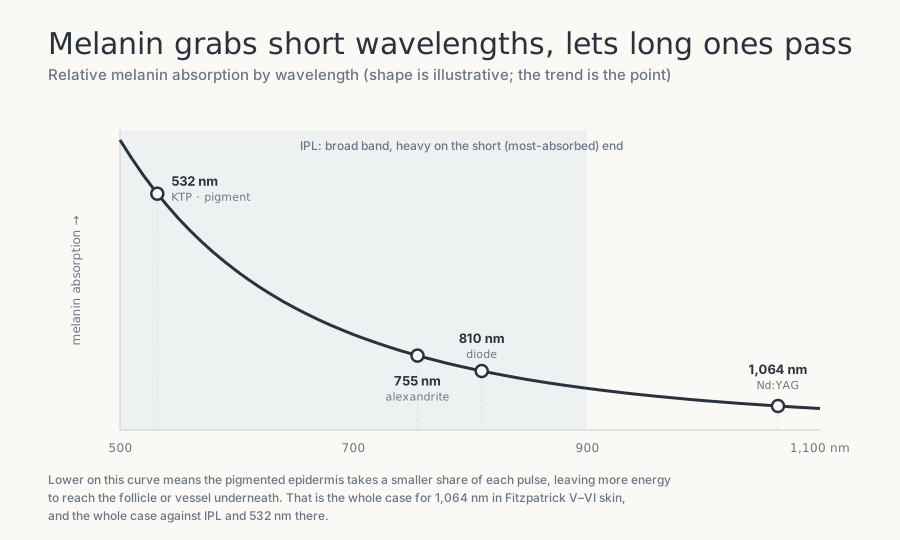
Melanin grabs short wavelengths and lets long ones pass. This is the physics behind every “which laser is safe for dark skin” answer on this page.
At 532 nm, or across the broad band an IPL emits, the epidermis in type V skin soaks up a large share of every pulse. At 1,064 nm, the Nd:YAG wavelength, melanin absorption is a small fraction of that, so far more energy passes through the pigmented surface to reach the follicle or vessel underneath. That single curve explains why the long-pulse Nd:YAG became the standard device for hair reduction in Fitzpatrick IV–VI skin [18][19][20], and why we won’t point an IPL at type V skin no matter how the sales rep phrases it. (We do offer hair reduction; it’s a small part of what we do and has its own page, but this guide is about safety, not sales.)
Our own hair reduction in types V–VI runs on the 810 nm diode rather than the 1,064 nm Nd:YAG, so it is worth being straight about what that means. Melanin absorbs 810 nm more strongly than 1,064 nm — that is what the curve above shows — which means the epidermis is not being protected by the wavelength. It is being protected by cooling: contact cooling at the handpiece and a Zimmer Cryo 6 chilled-air unit running on the treated skin throughout. The trial evidence for the diode at conservative fluence covers phototypes III–V [20]; type VI sits beyond it, which is why a delayed test spot is not optional there. And the energy is not what we reduce to stay safe. The section on paradoxical hypertrichosis below explains why backing the fluence off is the one adjustment that can make things worse.
Three more levers move the risk in the right direction, and every one of them is on the settings screen:
- Longer pulses. Stretching the pulse gives the thin epidermis time to shed heat while the bigger, slower-cooling follicle or vessel keeps accumulating it.
- Cooling. Chilling the surface before, during and after each pulse protects the epidermis directly. Contact cooling, cold air, or both.
- Test spots read at the right time. In types V–VI, a burn or a pigment reaction can take 48–72 hours to show. A test spot read at ten minutes is theater.
What goes wrong when devices are used badly
Every one of these is preventable, and every one of them walks into practices like ours after being done elsewhere.
- Burns and blisters. Too much epidermal absorption, usually from the wrong wavelength, a short pulse, no cooling, or treating tanned skin.
- Post-inflammatory hyperpigmentation (PIH). Dark patches that appear one to four weeks after a treatment injures the skin. The most common complication of any energy treatment in types IV–VI. Usually temporary, sometimes lasting a year or more, and much easier to prevent than to treat.
- Hypopigmentation. Light patches, from damage to melanocytes. Can be permanent. This is the outcome we design everything to avoid.
- Scarring. Rare, but more likely in darker skin after burns, and more likely again in anyone with a keloid history.
- Leukotrichia. White hairs after hair-reduction treatment; reported particularly after IPL [21].
- Paradoxical hypertrichosis. More hair after a treatment meant to remove it. Rare, poorly understood, and disproportionately a problem on the face and neck. Section below.
A few named devices deserve a direct word. IPL is not a laser; it’s a broad flash of many wavelengths, weighted toward the short ones melanin loves. Our own device’s manufacturer limits IPL to types I–IV, and so do we. Alexandrite (755 nm) hair-removal lasers are excellent in fair skin and a burn risk in dark skin. Full-field CO₂ resurfacing carries a well-documented PIH risk in types IV–VI [8][9]. And any device on tanned skin is a mistake: a tan is extra melanin the settings weren’t chosen for. We’ll reschedule you rather than treat a tan, and we’ll do it even when you’re annoyed.
Paradoxical hypertrichosis: when hair-removal laser grows hair
This is the complication nobody mentions at the consult, so we’re going to over-explain it.
What it is. New, thicker, darker hair appearing in or right next to an area that was treated to remove hair. It usually shows up after a few sessions rather than after the first one, and the new hair is often terminal hair growing where only fine vellus “peach fuzz” existed before.
How common. A 2021 systematic review pooling about 9,700 patients found an overall rate of roughly 3%, but with a striking pattern: almost all of it was on the face or neck, with a rate of only about 0.08% everywhere else on the body [22]. Facial series run higher. In one review of 543 women treated for facial hair, about 10% developed new hair, mostly in the beard area [23]. So the honest number is “rare on the body, not rare on the face.”
Who’s at risk. Consistently reported: treatment on the face or neck; women; fine dark vellus hair already present in the area before treatment; hormonal conditions such as polycystic ovary syndrome. Case series have reported it disproportionately in Fitzpatrick types III–V and in patients of Mediterranean, Middle Eastern and South Asian background [24][25][26]. We’ll be precise about the evidence here: the pooled analysis found the data on skin type too thin to confirm or rule out that association [22], and the largest facial series didn’t find one [23]. Treat “darker skin is a risk factor” as plausible and often reported, not proven.
What we think causes it. Here’s the part that matters for how a device gets used. The leading explanation, supported by the way these cases behave, is sub-therapeutic energy: a pulse that delivers enough heat to reach the follicle and disturb it, but not enough to destroy it [24][26][27]. A follicle that’s warmed but not killed doesn’t just shrug it off. Heat and the inflammation that follows it can push resting follicles into their growth phase, synchronize neighboring follicles, and convert fine vellus follicles into terminal ones. There are case reports of doubled hairs growing from single follicles after deliberately low-fluence treatments [28][29]. In short, a low dose isn’t a partial treatment. It can be a growth signal.
Two other clues point the same way. First, when the extra hair is treated again at an adequate, properly cooled setting, it usually responds; the original description of managing this complication was essentially “treat it correctly” [27], and the 2021 review found improvement with continued treatment in three of the four studies that tracked it [22]. Second, hair growth has also been reported after IPL used for skin treatments, not hair removal, at settings that were never meant to destroy a follicle [30]. Energy that reaches follicles without killing them seems to be the common thread.
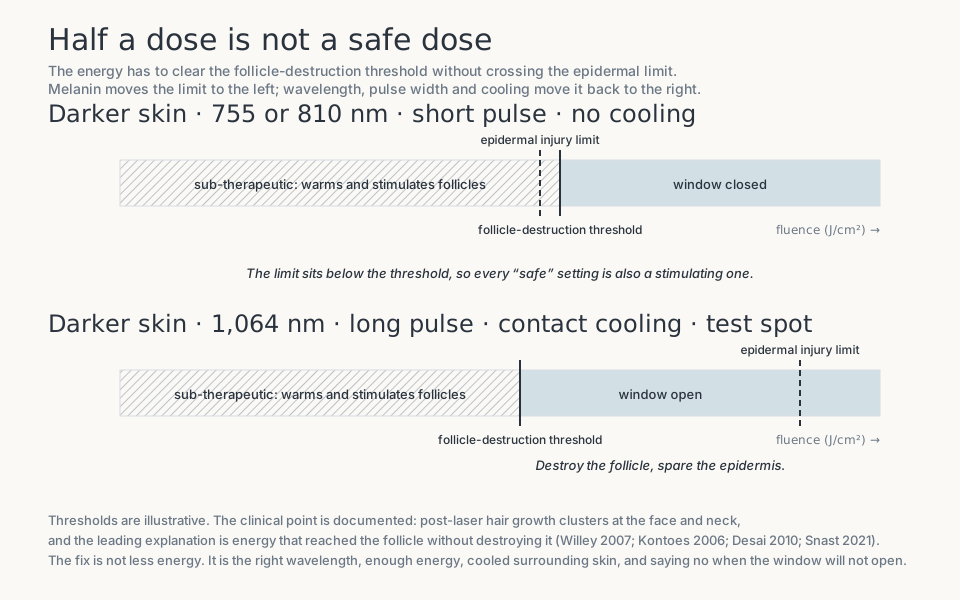
Half a dose is not a safe dose. Under-treating to protect the skin can land squarely in the range that stimulates hair. The lower row shows one way of opening the window — a wavelength melanin barely absorbs. Ours opens it the other way: 810 nm with contact cooling and a Zimmer Cryo 6 chilled-air unit, at adequate fluence. In both rows the levers doing the work are pulse width and cooling, never a smaller dose.
Why this matters more in darker skin. Every hair-removal setting has to clear two bars: enough energy to destroy the follicle, and not so much that the epidermis burns. In fair skin those two bars are far apart. In darker skin, with a device that melanin absorbs strongly, they move toward each other until there may be no gap at all. An operator who’s worried about burning you will naturally turn the energy down, and now every pulse lands in the zone that stimulates hair instead of the zone that kills it. That’s the trap: under-treating to be safe is how you get hair on someone’s jawline.
The fix is not less energy. It’s choosing the wavelength that opens the window back up (1,064 nm in types V–VI), stretching the pulse, cooling the surrounding skin so the edge of each spot, where energy tails off into the sub-therapeutic range, doesn’t warm the neighbors, and using enough energy to reach the endpoint we’re looking for. Where the window won’t open, we say so, and you keep your money.
What we do about it here. We counsel every facial hair-reduction patient about it before the first session. We treat the face and neck at adequate, cooled, tested settings rather than timid ones. We’re careful with patients who have a lot of fine dark facial hair, and we ask about hormonal history because untreated PCOS is a set-up for disappointment. If it happens, we tell you, and we treat it properly rather than abandoning the plan.
What we use for darker skin, and why
| Concern | What we reach for in types IV–VI | Why | What we avoid |
|---|---|---|---|
| Unwanted hair | 810 nm diode with contact cooling and a Zimmer Cryo 6 chilled-air unit, at adequate fluence and after a delayed test spot in types V–VI | Melanin absorbs 810 nm more than 1,064 nm, so aggressive cooling rather than the wavelength is what protects the epidermis; long pulses help, and low fluence does not [20] | IPL, alexandrite, short pulses, treating tans |
| Facial vessels, leg spider veins | Long-pulse 1,064 nm Nd:YAG | Same physics: hemoglobin still absorbs at 1,064, melanin much less | IPL, 532 nm in types V–VI |
| Sun spots, PIH, melasma | Low-energy Q-switched 1,064 nm (“laser toning”), prescription topicals, strict sunscreen | Targets pigment with minimal heat; melasma is heat-reactive and needs the gentlest approach | IPL, aggressive pigment lasers, anything hot |
| Texture, acne scars, early laxity | RF microneedling | Radiofrequency is delivered by needles, not light, so it doesn’t interact with melanin at all; studies in types IV–V show low PIH rates [31][32] | Full-field CO₂; aggressive ablative resurfacing |
| Fine lines, sun damage, surface lesions | Conservative erbium:YAG resurfacing (types IV–V; VI with added caution) | Minimal residual heat, precise depth; see our erbium vs CO₂ guide | Full-field CO₂ [8][9] |
| Wrinkles, volume | Neuromodulators, HA filler, PRP | Injectables don’t use light; skin tone is irrelevant to safety | Nothing tone-specific |
Two things to notice in that table. First, “safe” is never just the device; it’s the device plus the wavelength plus the pulse plus the cooling plus the test spot plus the operator. Second, for texture and scarring, the best tool in darker skin is one that isn’t a laser at all. RF microneedling is genuinely colorblind and, for acne scars in types IV–VI, it’s usually where we start.
Our skin-of-color protocol
Every energy treatment here in types IV–VI runs through the same steps, and they’re not negotiable:
- Consultation first, free, no treatment room required. We score your Fitzpatrick type together, then examine the skin itself, including under a dermatoscope where it helps.
- History that matters. Recent sun, tanning beds, tanning products, hormonal conditions, keloid history, prior pigment reactions to injury, and the medications that make skin more light-reactive.
- Test spot, read at the right interval. For types V–VI on hair-reduction and pigment devices, that’s 48–72 hours, not ten minutes.
- Conservative first session, then titrate. We’d rather add energy at session two than apologize after session one.
- Pigment plan in place before we start. Sunscreen daily, a pre-treatment topical regimen where it’s indicated, and clear instructions on what to watch for and when to call.
- Longer intervals. Darker skin often needs more time between sessions to fully settle. We schedule for that.
- No tanned skin. No exceptions.
What we’ll be honest about
Some people will leave the consult without a treatment plan because the safe window for what they want doesn’t exist on our platform, or doesn’t exist at all. Deep resurfacing on type VI skin. IPL for anyone above type IV. Fast, aggressive hair reduction on a tanned face. We’ll tell you, and we’ll tell you what we’d do instead, even when “instead” is a referral out or a prescription that costs twenty dollars.
Frequently asked
Is laser treatment safe for dark skin?
Yes, with the right device and the right settings, and no with the wrong ones. Long-pulse 1,064 nm Nd:YAG, RF microneedling, and conservative erbium resurfacing all have good safety records in Fitzpatrick IV–VI skin. IPL, alexandrite hair lasers, and full-field CO₂ don’t. The operator matters as much as the device.
What is the best laser for dark skin?
For vessels, the long-pulse 1,064 nm Nd:YAG, because melanin barely absorbs that wavelength. For hair in types V–VI we run the 810 nm diode instead, at adequate fluence under contact cooling and a Zimmer Cryo 6 chilled-air unit — melanin absorbs 810 nm more, so the cooling is what protects the skin. For texture and scars, the best “laser” is often not a laser: RF microneedling doesn’t interact with pigment at all. For resurfacing, erbium:YAG used conservatively.
What is my Fitzpatrick skin type?
It’s based on how your skin responds to sun: type I always burns and never tans; type VI never burns and is deeply pigmented; the rest are in between. It’s a rough guide, not a measurement. We score it with you at consultation and then look at your actual skin.
Is IPL safe for dark skin?
No. IPL emits a broad band of light weighted toward wavelengths that melanin absorbs strongly. Our device’s manufacturer limits it to types I–IV, and so do we.
Can laser hair removal cause more hair growth?
Rarely, yes. Paradoxical hypertrichosis affects roughly 3% of patients overall but is concentrated almost entirely on the face and neck. The leading explanation is energy that warms follicles without destroying them, which is why timid settings are a risk, not a safety measure. It usually responds to continued treatment at adequate, cooled settings.
Is RF microneedling safe for dark skin?
It’s one of the safest energy treatments available for types IV–VI, because the energy is delivered by needles rather than light and doesn’t interact with melanin. Post-treatment darkening is still possible with any skin injury, so we still prepare the skin and go conservatively.
Can Black skin get laser resurfacing?
Conservative erbium:YAG resurfacing is an option for many people in types IV–V with a test spot, staged sessions, and a pigment plan. For type VI we’ll talk it through individually; RF microneedling is often the better answer for the same concerns.
Why won’t you treat me if I have a tan?
Because a tan is extra melanin the settings weren’t chosen for, and the device can’t tell a tan from a target. We’d rather reschedule than burn you.
Sources
- Ruiz-Esparza J, Lupton JR. Laser resurfacing of darkly pigmented patients. Dermatol Clin. 2002;20(1):113–121. Find on PubMed
- Chan NP, Ho SG, Yeung CK, Shek SY, Chan HH. Fractional ablative carbon dioxide laser resurfacing for skin rejuvenation and acne scars in Asians. Lasers Surg Med. 2010;42(9):615–623. doi:10.1002/lsm.20974
- Fitzpatrick TB. The validity and practicality of sun-reactive skin types I through VI. Arch Dermatol. 1988;124(6):869–871. doi:10.1001/archderm.1988.01670060015008
- Alster TS, Bryan H, Williams CM. Long-pulsed Nd:YAG laser-assisted hair removal in pigmented skin: a clinical and histological evaluation. Arch Dermatol. 2001;137(7):885–889. PMID 11453807
- Nanda S, Bansal S. Long pulsed Nd:YAG laser with inbuilt cool sapphire tip for long term hair reduction on type-IV and V skin: a prospective analysis of 200 patients. Indian J Dermatol Venereol Leprol. 2010;76(6):677–681. doi:10.4103/0378-6323.72467
- Royo J, Urdiales F, Moreno J, Al-Zarouni M, Cornejo P, Trelles MA. Six-month follow-up multicenter prospective study of 368 patients, phototypes III to V, on epilation efficacy using an 810-nm diode laser at low fluence. Lasers Med Sci. 2011;26(2):247–255. doi:10.1007/s10103-010-0846-1
- Radmanesh M, Azar-Beig M, Abtahian A, Naderi AH. Burning, paradoxical hypertrichosis, leukotrichia and folliculitis are four major complications of intense pulsed light hair removal therapy. J Dermatolog Treat. 2008;19(6):360–363. doi:10.1080/09546630802132627
- Snast I, Kaftory R, Lapidoth M, Levi A. Paradoxical hypertrichosis associated with laser and light therapy for hair removal: a systematic review and meta-analysis. Am J Clin Dermatol. 2021;22(5):615–624. doi:10.1007/s40257-021-00611-w — 9,733 patients; pooled prevalence 3% (95% CI 1–6); 0.08% at sites other than the face and neck; skin-type data insufficient. Competing interest: this publication was supported by Alma Lasers. It is the source of the 3% figure quoted above, and we would rather you knew that.
- Willey A, Torrontegui J, Azpiazu J, Landa N. Hair stimulation following laser and intense pulsed light photo-epilation: review of 543 cases and ways to manage it. Lasers Surg Med. 2007;39(4):297–301. doi:10.1002/lsm.20485
- Alajlan A, Shapiro J, Rivers JK, MacDonald N, Wiggin J, Lui H. Paradoxical hypertrichosis after laser epilation. J Am Acad Dermatol. 2005;53(1):85–88. doi:10.1016/j.jaad.2004.06.054
- Moreno-Arias G, Castelo-Branco C, Ferrando J. Paradoxical effect after IPL photoepilation. Dermatol Surg. 2002;28(11):1013–1016. PMID 12460295
- Desai S, Mahmoud BH, Bhatia AC, Hamzavi IH. Paradoxical hypertrichosis after laser therapy: a review. Dermatol Surg. 2010;36(3):291–298. doi:10.1111/j.1524-4725.2009.01433.x
- Kontoes P, Vlachos S, Konstantinos M, Anastasia L, Myrto S. Hair induction after laser-assisted hair removal and its treatment. J Am Acad Dermatol. 2006;54(1):64–67. doi:10.1016/j.jaad.2005.09.034
- Ye JN, Prasad A, Trivedi P, Knapp DP, Chu P, Edelstein LM. Pili bigeminy induced by low fluence therapy with hair removal alexandrite and ruby lasers. Dermatol Surg. 1999;25(12):969. doi:10.1046/j.1524-4725.1999.99102.x
- Bukhari IA. Pili bigemini and terminal hair growth induced by low-fluence alexandrite laser hair removal. J Cutan Med Surg. 2006;10(2):96–98. Find on PubMed
- Vlachos SP, Kontoes PP. Development of terminal hair following skin lesion treatments with an intense pulsed light source. Aesthetic Plast Surg. 2002;26(4):303–307. Find on PubMed
- Chandrashekar BS, Sriram R, Mysore R, Bhaskar S, Shetty A. Evaluation of microneedling fractional radiofrequency device for treatment of acne scars. J Cutan Aesthet Surg. 2014;7(2):93–97. doi:10.4103/0974-2077.138328
- Cho SI, Chung BY, Choi MG, et al. Evaluation of the clinical efficacy of fractional radiofrequency microneedle treatment in acne scars and large facial pores. Dermatol Surg. 2012;38(7 Pt 1):1017–1024. doi:10.1111/j.1524-4725.2012.02402.x
Newport News · Virginia
Start with a consultation. It’s free.
Every plan here starts with a conversation. Bring your questions — we’ll give you a realistic picture of what each option can and can’t do, including when the answer is to wait or to start somewhere simpler.
Takes about a minute. You'll come back here to a confirmation page when you're booked — if you don't get there, call (757) 586-4575, any hour.