Rosacea · Newport News
Rosacea treatment in Newport News.
Creams quiet the flares. They don’t close the vessels. That part is ours. Treated on Jefferson Avenue in Newport News near Kiln Creek, on the same platform we use for sun damage.
Rosacea is best understood as a thermostat problem. The blood vessels in your face are supposed to open when you’re hot or embarrassed and close when the moment passes. With rosacea, the thermostat sticks: vessels open too easily, too often, and — over years — some stop closing at all. That’s the progression most people notice: first flushing that comes and goes, then a background pinkness that never fully leaves, then individual broken capillaries you can trace in the mirror.
Here’s the part that saves you months of frustration: the treatments that help one part of rosacea do almost nothing for the others.
Which tool fixes which problem
Persistent redness and visible vessels — this is what we treat. Once a vessel has been stuck open long enough, no cream closes it. Light and laser do it directly: IPL for diffuse background redness ($300 per session, full face), and the long-pulse Nd:YAG vascular laser for individual telangiectasias — the mapped-out capillaries — where a focused beam collapses the vessel so your body reabsorbs it. Roads the town no longer needs, closed and reclaimed. Most patients want a short series, typically two to four sessions about a month apart, then occasional maintenance.
Bumps and breakouts (the acne-looking part) — that’s medical therapy, not laser. Prescription topicals and, sometimes, a course of oral medication. As a prescribing practice we can start appropriate topical therapy or coordinate it, and we’ll be straight with you about when the inflammatory component needs a dermatologist managing it long-term.
Eye involvement (gritty, bloodshot, irritated) — that’s ocular rosacea, and it belongs with an eye-care provider. We’ll tell you if we see signs of it.
What flare management actually looks like
Laser fixes the vessels that already gave up; it doesn’t fire your triggers. The honest maintenance program is boring and works: know your top two or three triggers (heat, alcohol, sun, and spicy food lead the league), a bland routine — gentle cleanser, plain moisturizer, mineral sunscreen — and skip the scrubs, fragrance, and alcohol-heavy toners entirely. Reactive skin wants fewer products, not more. We’ll write out your specific routine at the consult, using drugstore products; there’s nothing to buy from us.
What to expect from treatment
IPL sessions take about 20 minutes; you’ll be pink for a day or two, like modest sun exposure. Vessel-by-vessel laser work can leave small red marks that fade over days. Improvement builds across the series as treated vessels clear — judge it at the end of the series, in the same mirror and lighting, not the morning after session one.
And the expectation-setting a friend owes you: rosacea is a managed condition, not a cured one. The thermostat stays quirky. What changes is the baseline — treated skin sits calmer, flushes less visibly, and no longer shows the road map. New vessels can recruit over years; occasional maintenance sessions keep the baseline where you like it.
Booking the right appointment
The two vascular jobs described above are booked as separate appointments, because they are different sessions with different settings and different amounts of time:
- Rosacea — the laser and IPL treatment for the vascular component: background redness and flushing across the cheeks, nose and chin. $400 a session.
- Facial Telangiectasias: individual broken capillaries you can trace in the mirror, closed one vessel at a time rather than treated as a field.
Most faces carry some of both, and you don’t have to sort that out on a booking screen — pick whichever is closer, and we will plan the series properly at the consultation, which is free. The bumps and the eye symptoms are not laser appointments at all; those are the conversations described above.
Two manufacturer photographs of facial redness
Both slides came from Rohrer Aesthetics, who build the Spectrum platform, and both were taken with IPL — the tool described above for diffuse background redness rather than for vessels treated one at a time. We publish them because the redness pictured is the concern this page is about, not as documented rosacea cases. The rest of the manufacturer material we publish is on our before and after page.
-
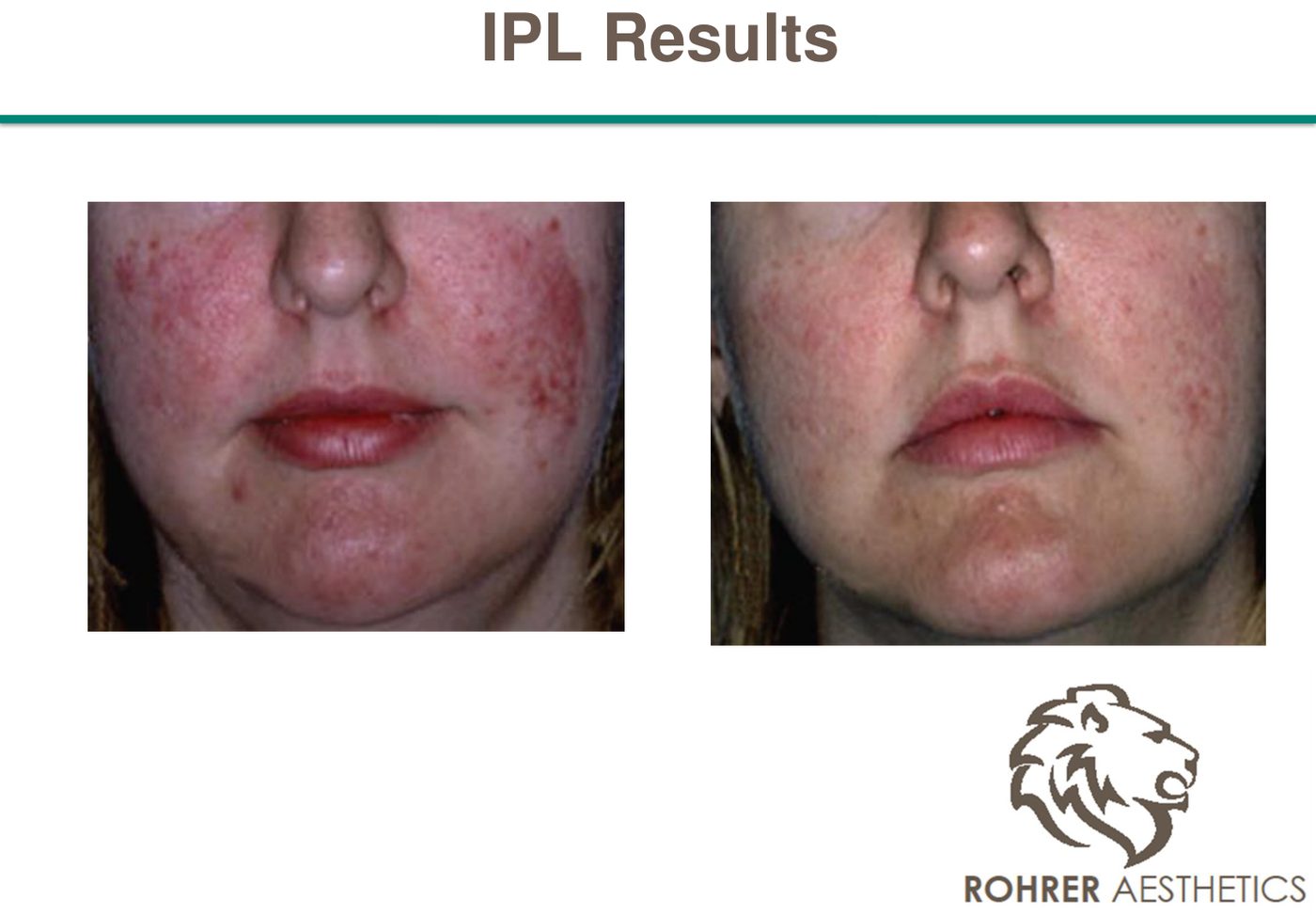
Redness across both cheeks and the chin with inflamed bumps running through it. In the after frame the redness is paler and the bumps are fewer; background colour remains on both cheeks.
Rohrer Aesthetics slide · no clinician credited · not a patient of this practice
-
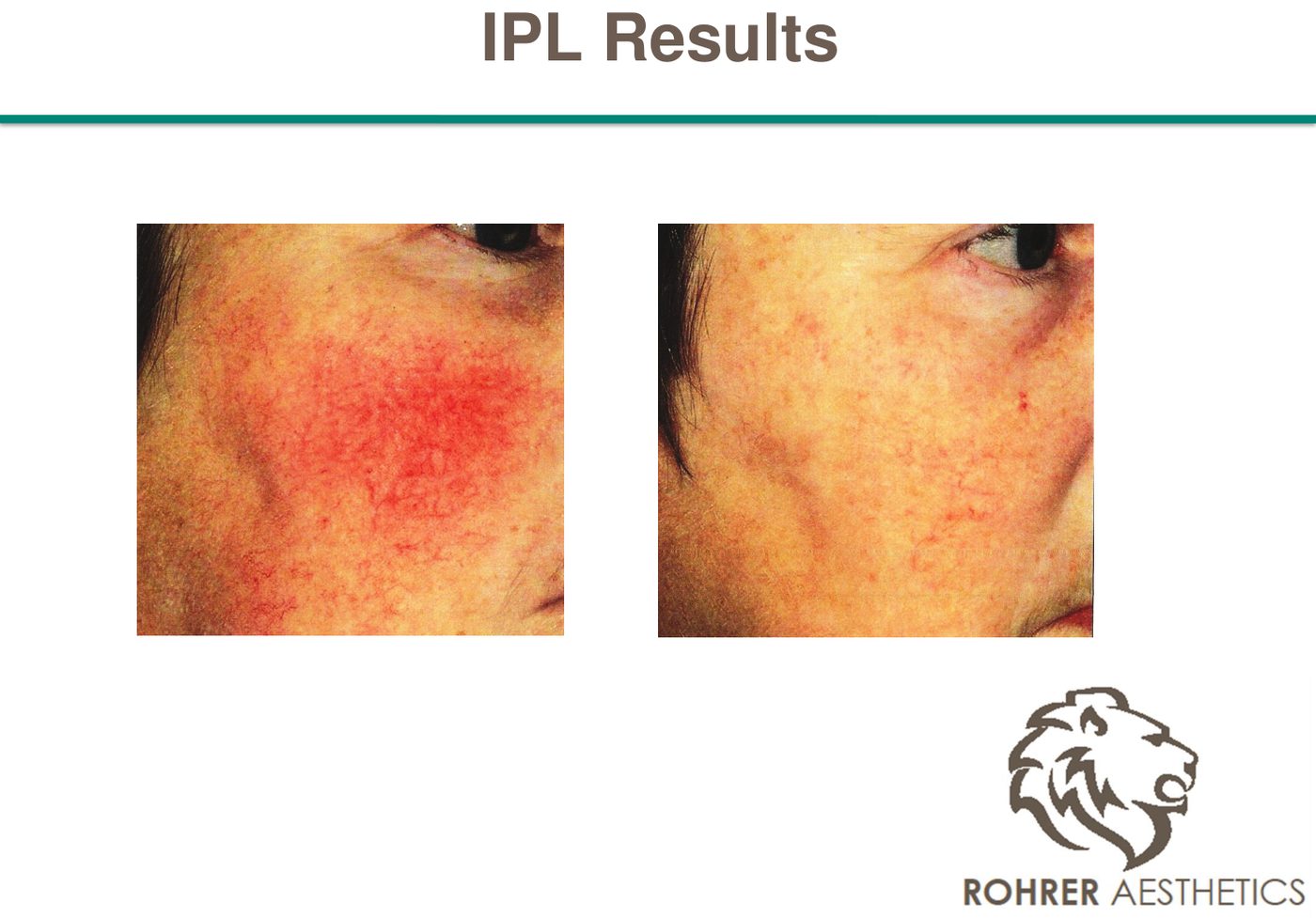
A dense patch of diffuse redness over the cheek. In the after frame it reads as scattered fine vessels rather than a solid flush, and the vessels are still visible.
Rohrer Aesthetics slide · no clinician credited · not a patient of this practice
Questions
Do I need a dermatologist for rosacea?
Sometimes, and we’ll tell you when. Severe inflammatory rosacea, anything needing long-term oral medication management, and unclear diagnoses belong with dermatology. The vascular component — persistent redness and visible vessels — responds to IPL and vascular laser, which is exactly what we do. Plenty of patients use both: dermatology for the medical side, us for the vessels.
What’s the best treatment for rosacea redness?
For fixed background redness and broken capillaries, light-based treatment is the standard: IPL for diffuse redness, vascular laser for individual vessels. Topicals help flushing and bumps but can’t remove a vessel that’s permanently open.
How many sessions does it take?
Most patients see meaningful change across two to four sessions spaced about a month apart, then maintenance once or twice a year as needed. We’ll estimate your number at the consult based on how much is diffuse redness versus mapped vessels.
How much does rosacea laser treatment cost?
The rosacea vascular protocol is $400 a session. Full-face IPL for diffuse background redness on its own is $300. Small, focused vessel sessions cost less; we publish prices and plan the series with you before anything is booked.
Will rosacea come back after laser?
The vessels we close stay closed. Rosacea itself persists, so new vessels can appear over time — slower if triggers and sun are managed. Think of it as resetting the clock, then winding it slower.
Can you treat the pimple-like bumps too?
Those need prescription therapy rather than laser. We can start appropriate topicals and will refer honestly when the inflammatory component needs ongoing dermatologic management.
Two ways to book
Call us — no login needed
(757) 586-4575. Answered 24 hours a day, including evenings and Saturdays. Most people are booked in about a minute.
Book online
Pick your time on our scheduler. New patients set up a quick login at the last step — that's how you reschedule yourself later. When you're done you'll land back here on a Booking confirmed page.
Didn't reach the confirmation page? Then nothing was booked — give us a call and we'll take care of it.
Newport News · Virginia
Start with a consultation. It’s free.
Every plan here starts with a conversation. Bring your questions — we’ll give you a realistic picture of what each option can and can’t do, including when the answer is to wait or to start somewhere simpler.
Takes about a minute. You'll come back here to a confirmation page when you're booked — if you don't get there, call (757) 586-4575, any hour.