IPL Photofacial · Newport News
IPL photofacial in Newport News.
One treatment, two targets: the brown the sun left behind, and the red that never quite fades. Both treated on one platform, in two treatment rooms on Jefferson Avenue in Newport News near Kiln Creek.
IPL isn’t technically a laser — it’s an extremely bright, extremely fast flash of broad-spectrum light, filtered down to the wavelengths that the target absorbs. Think of the filters as choosing which key fits which lock: one configuration hunts brown pigment, another hunts the red of hemoglobin in dilated vessels. Skin that’s neither brown-spotted nor red mostly ignores the flash. That selectivity is the whole trick, and it’s why one platform can treat sun spots, diffuse redness, and the mixed damage on necks and chests that’s a bit of both.
Our IPL runs on the Rohrer Spectrum with four filter configurations, which means we target by wavelength instead of treating every face with the same setting — and every treatment is matched to your skin type, not a preset. If your skin is Fitzpatrick IV or darker, our guide to laser and energy treatments in darker skin explains what we will and will not use.
How it works
Five steps, start to finish — from the lamp firing to what your skin looks like a week later.
A flash, not a beam.
A laser emits one wavelength. IPL is a xenon flashlamp: a very bright, very short burst carrying hundreds of wavelengths at once, roughly 400 to 1,200 nm. On its own that is useless — most of that light would land where you don't want it.
The filter does the choosing.
A cut-off filter blocks everything below a chosen wavelength. Move the cut-off up and the surviving light goes deeper and is taken up less by pigment sitting in the surface of the skin. Our platform carries four configurations; which one we use is decided by your skin and your target, not by a preset.
Two targets, two appetites.
Light only does work where something absorbs it. Melanin — the brown of a sun spot — absorbs hardest at short wavelengths and steadily less as they lengthen. Oxyhemoglobin, the red inside a dilated vessel, has sharp peaks near 542 and 577 nm and a second, smaller one out near 940. Skin that is neither brown-spotted nor red has nothing to absorb the flash, so it mostly ignores it.
Heat it faster than the heat can spread.
Absorbed light becomes heat. The rule — selective photothermolysis — is to deliver enough of it to destroy the target while the pulse is still shorter than the time that target needs to shed heat into its neighbors. The spot cooks. The skin a hair's breadth away does not.
Then your skin does the rest.
Treated pigment darkens over two or three days — like toast, and that darkening is the treatment working, not a burn — then lifts off over roughly a week. Treated vessels collapse and clear. What it will not do is listed above, because it is easier to hear now than after a deposit.
Read it instead
1 · A flash, not a beam.
A laser emits one wavelength. IPL is a xenon flashlamp: a very bright, very short burst carrying hundreds of wavelengths at once, roughly 400 to 1,200 nm.
2 · The filter does the choosing.
A cut-off filter blocks everything below a chosen wavelength. Move the cut-off up and the surviving light goes deeper and is taken up less by pigment in the surface of the skin.
3 · Two targets, two appetites.
Melanin absorbs hardest at short wavelengths and less as they lengthen. Oxyhemoglobin peaks near 542 and 577 nm, with a smaller peak near 940. Skin that is neither brown-spotted nor red has nothing to absorb the flash.
4 · Heat it faster than the heat can spread.
Selective photothermolysis: deliver enough energy to destroy the target while the pulse is still shorter than the time that target needs to shed heat into its neighbors.
5 · Then your skin does the rest.
Treated pigment darkens over two or three days, then lifts off over roughly a week. Treated vessels collapse and clear. IPL will not change texture, pores or wrinkles; it can worsen melasma; and tanned skin is rescheduled rather than treated.
What it treats well
Sun spots and uneven brown tone. Lentigines — the flat brown spots decades of sunlight leave on faces, necks, and chests. After treatment the spots darken like toast over a few days, then flake away over about a week. That darkening is the treatment working, not a burn; plan social events accordingly.
Diffuse redness and flushing. The background pink that’s really thousands of tiny dilated vessels. IPL treats the field all at once, which is why it’s our workhorse for the vascular component of rosacea.
The mottled red-brown on necks and chests. If your neck and upper chest show a mix of redness, brown discoloration, and thin skin — usually sparing the shaded patch under the chin — that pattern has a name: poikiloderma of Civatte. It’s sun damage with both a pigment and a vascular component, which is exactly the combination IPL is built for. It’s treated as its own protocol here, and it’s one of the most satisfying things we treat, because most people assumed it was permanent.
What it doesn’t treat
The honest list. Texture, pores, and wrinkles — that’s resurfacing or microneedling territory; IPL changes color, not architecture. Melasma — IPL can worsen it; melasma gets a conservative, dedicated approach here, not a photofacial. Deeply tanned or recently sun-exposed skin — we reschedule rather than treat, because the light can’t tell a tan from a target. And on deeper skin tones, IPL requires careful case-by-case judgment; sometimes the right answer is a different device, and we’ll tell you which.
Pricing
| Treatment | Price |
|---|---|
| IPL photofacial — face | $300 |
| IPL photofacial — face, neck and chest | $500 |
| IPL photofacial — face, series of 3 | $800 |
| IPL photofacial — face, neck and chest, series of 3 | $1,200 |
| Spot treatment (1–5 spots) | $200 |
| Poikiloderma protocol — neck / chest | $450 |
| IPL hand rejuvenation | $200 |
A full face-neck-chest session is $500 — treated in one visit, one recovery window. Most people want a short series, typically three sessions about a month apart, then a maintenance session once or twice a year as new sun exposure accumulates. A series of three can be bought up front — $800 for the face, or $1,200 for face, neck and chest — which saves $100 and $300 against paying session by session. Paying as you go is still an option at the single-session price, so if you would rather do one and see how your skin responds first, that is a reasonable way to start.
Book the one you want
- Book IPL photofacial — full face — $300 a session.
- Book IPL — face, neck & chest — $500, all three areas in one visit.
- Book IPL hand rejuvenation — $200 a session, described on the hand rejuvenation page.
Spot treatments and the poikiloderma protocol are not among the three options above. Ask for either at your free consultation, or call us, and we will put it on the schedule for you.
What a session is like
Cold gel, protective eyewear, and a series of bright flashes — each feels like a warm rubber-band snap. A full face takes about twenty minutes. You’ll leave a little pink, like a brisk walk in the cold; spots darken over the following days, then flake. Makeup is fine the next day. The non-negotiable afterward is sunscreen: IPL removes the damage you’ve collected, and only SPF keeps you from re-collecting it. We’ll go over which one and how to use it at your visit.
Five manufacturer photographs of IPL
These five slides came from Rohrer Aesthetics, who build the Spectrum platform our IPL runs on. Three of them show brown sun pigment and two show redness — the two things IPL is for — and in every one of them something is left behind rather than erased, which is the honest shape of this treatment.
-
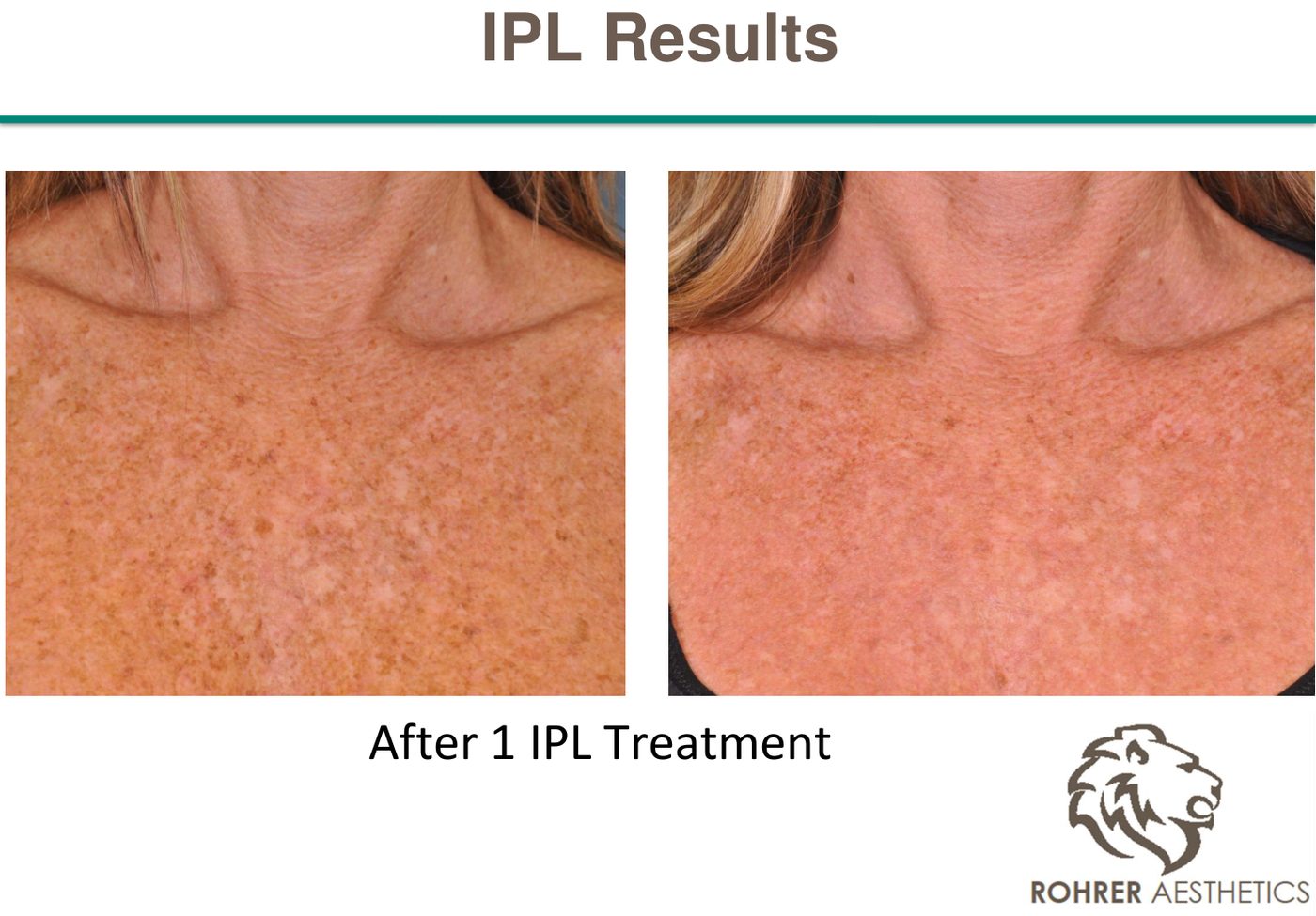
Mottled sun pigment across the neck and upper chest. The slide is printed “After 1 IPL Treatment”. In the after frame the mottling is lighter and more even; a good deal of freckling is still there.
Rohrer Aesthetics slide · no clinician credited · not a patient of this practice
-
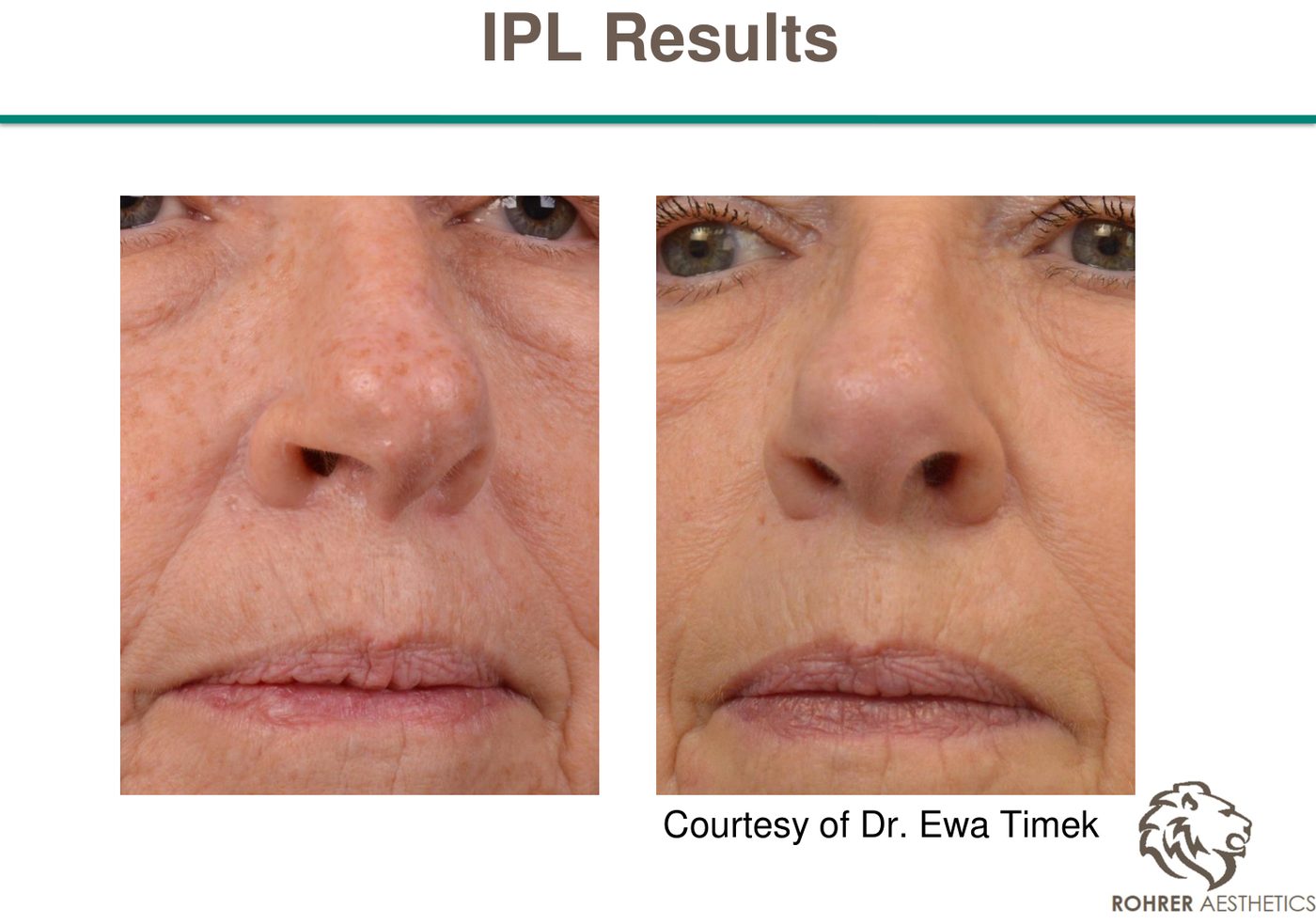
Scattered brown spots across the nose, cheeks and upper lip. Fewer and fainter in the after frame. The lines and the skin texture look much the same in both.
Rohrer Aesthetics slide · courtesy of Dr. Ewa Timek · not a patient of this practice
-
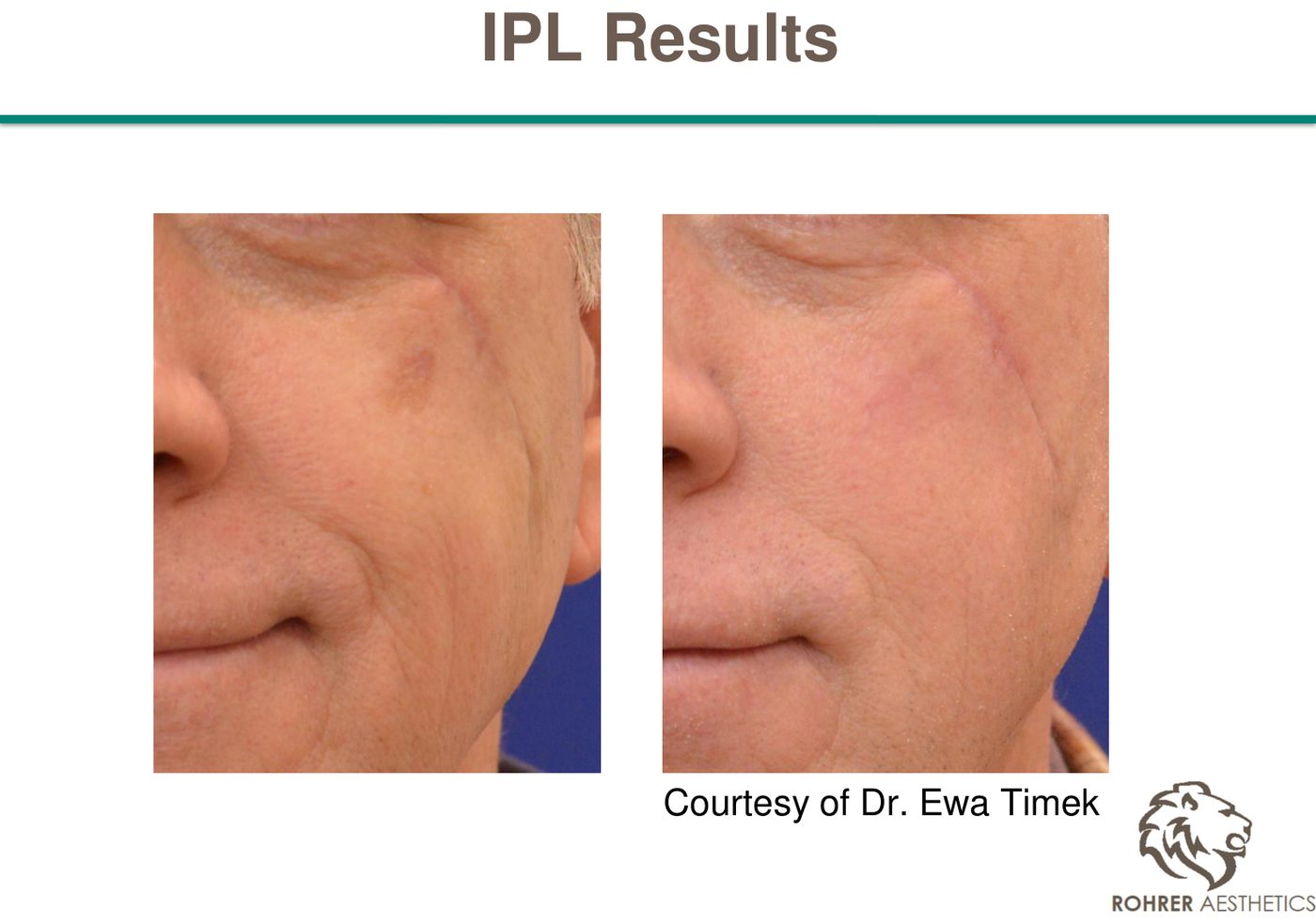
One well-defined brown spot on the upper cheek. It is not present in the after frame. Nothing else about the cheek — lines, pores, overall colour — has changed.
Rohrer Aesthetics slide · courtesy of Dr. Ewa Timek · not a patient of this practice
-
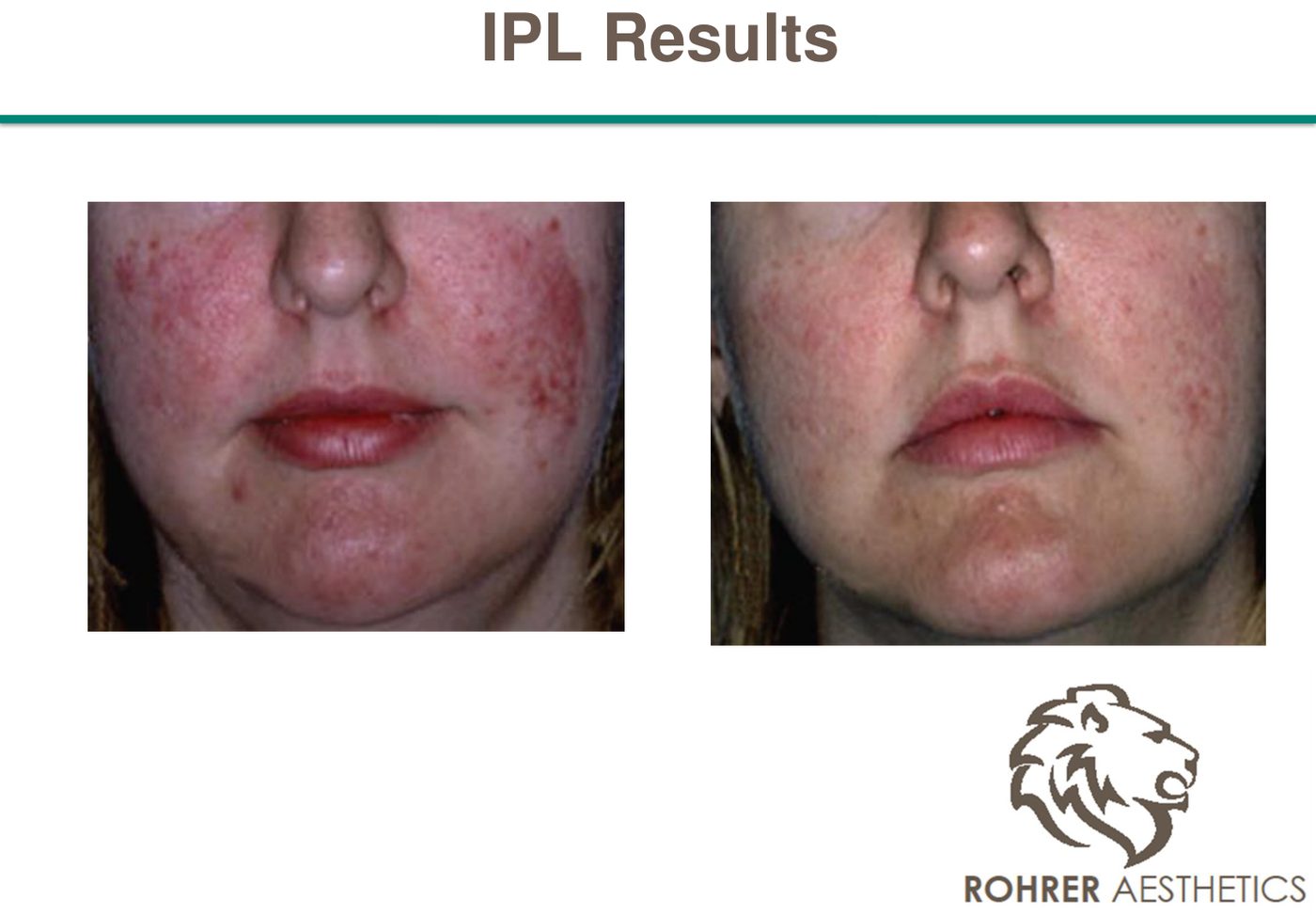
Redness across both cheeks and the chin with inflamed bumps running through it. In the after frame the redness is paler and the bumps are fewer; background colour remains on both cheeks.
Rohrer Aesthetics slide · no clinician credited · not a patient of this practice
-
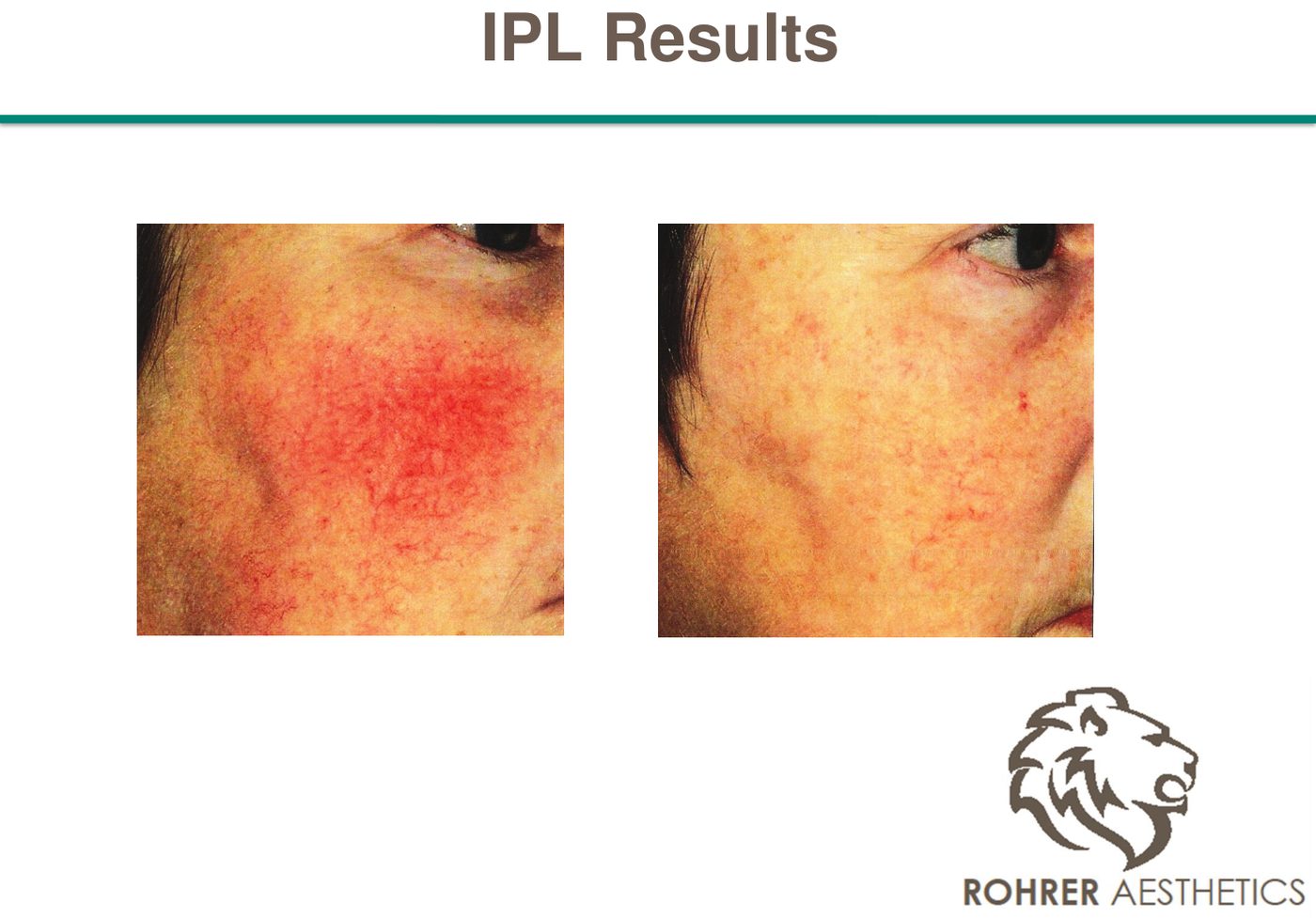
A dense patch of diffuse redness over the cheek. In the after frame it reads as scattered fine vessels rather than a solid flush, and the vessels are still visible.
Rohrer Aesthetics slide · no clinician credited · not a patient of this practice
Questions
What is an IPL photofacial?
A treatment that uses filtered pulses of intense light to break up brown sun spots and close down the tiny vessels behind facial redness. Treated spots darken and flake off within about a week; redness fades gradually across a short series. It changes skin color problems, not texture.
How much does an IPL photofacial cost?
Here: $300 for the face, and $500 for the face, neck and chest treated together in one session. Small spot treatments are $200. Most plans run about three sessions. A series of three is $800 for the face and $1,200 for face, neck and chest, bought up front; you can also pay one session at a time at the single-session price.
What is the mottled red-brown skin on my neck and chest?
Very likely poikiloderma of Civatte — chronic sun damage with both pigment and vascular components, usually sparing the shaded area under the chin. It responds well to IPL because the treatment addresses brown and red in the same pass. We treat it as a dedicated protocol at $450 per session.
How many sessions will I need?
Typically three, about a month apart, then occasional maintenance. Heavier sun damage takes more; a scattering of spots may take fewer. You’ll get a specific estimate at your free consultation.
Does IPL work on melasma?
No. Melasma is heat- and light-reactive, and IPL can make it darker. If your pigment is melasma, we’ll steer you to the conservative approach it actually needs: strict tinted mineral sunscreen, prescription topicals, and low-fluence laser toning where appropriate.
Does it hurt?
Each pulse is a quick warm snap — startling more than painful. No numbing needed for most people, and there’s no downtime beyond a day of pinkness and a week of darker, flaking spots.
Two ways to book
Call us — no login needed
(757) 586-4575. Answered 24 hours a day, including evenings and Saturdays. Most people are booked in about a minute.
Book online
Pick your time on our scheduler. New patients set up a quick login at the last step — that's how you reschedule yourself later. When you're done you'll land back here on a Booking confirmed page.
Didn't reach the confirmation page? Then nothing was booked — give us a call and we'll take care of it.
Newport News · Virginia
Start with a consultation. It’s free.
Every plan here starts with a conversation. Bring your questions — we’ll give you a realistic picture of what each option can and can’t do, including when the answer is to wait or to start somewhere simpler.
Takes about a minute. You'll come back here to a confirmation page when you're booked — if you don't get there, call (757) 586-4575, any hour.